
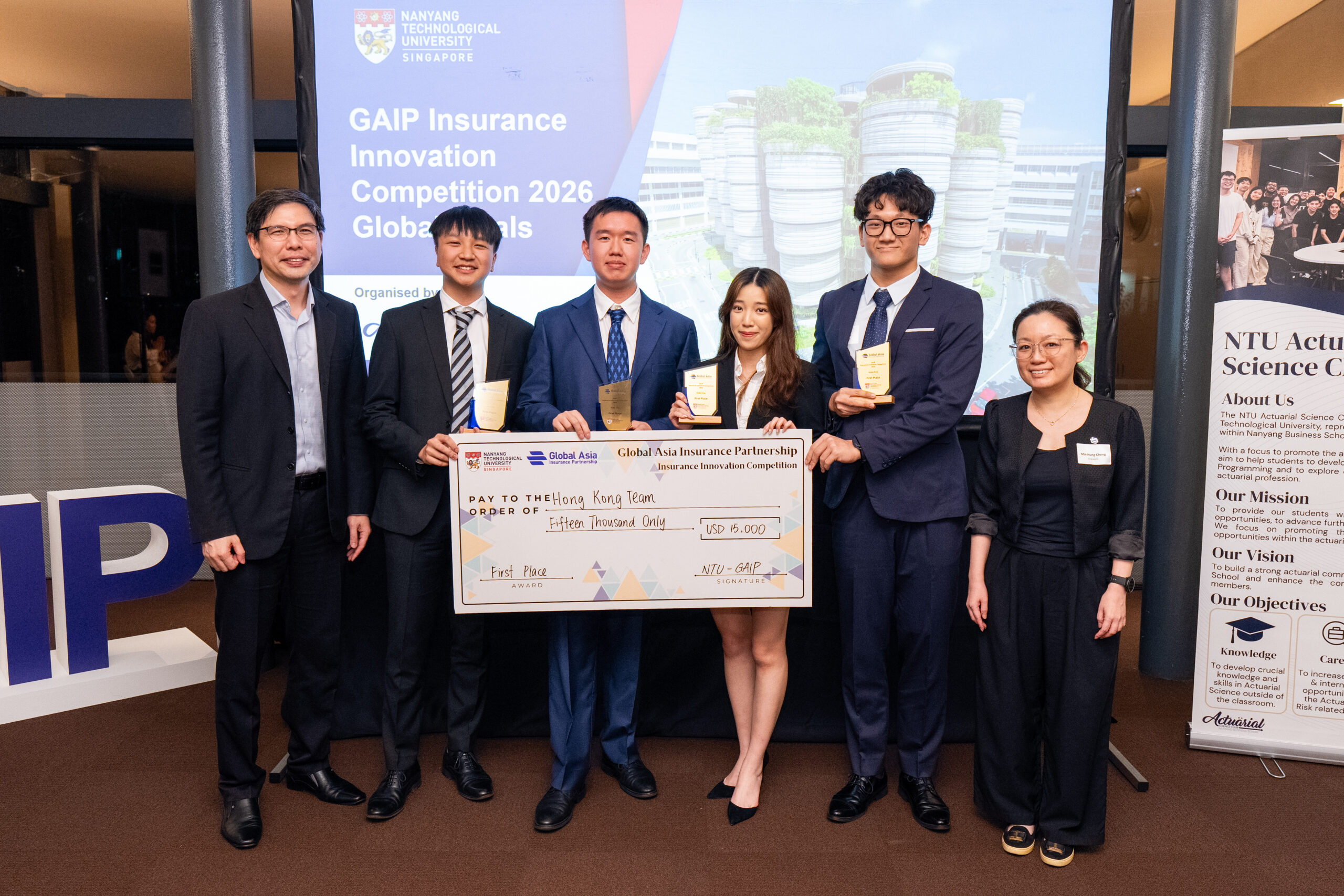
[24 August 2026], Singapore — Team Hong Kong from the Hong Kong University of Science and Technology emerged as the winner of the Global Asia Insurance Partnership (GAIP) Insurance Innovation Competition 2026 Global Finals, taking home the top prize of USD 15,000 for their innovation on an AI-powered student micro-insurance, built for every campus moment. The prestigious competition held in Singapore was organised by GAIP and the Nanyang Technological University (NTU Singapore), in partnership with universities across the region.
Now in its 4th year, the competition gives university students a platform to showcase their analytical, research, and presentation skills by developing real-world insurance innovation proposals, with the aim of promoting innovation and strategic thinking within the insurance industry. In previous years, proposals developed through the competition have attracted interest from industry stakeholders and regulators, highlighting the potential for student-led ideas to contribute to real-world industry challenges.
This year's competition saw participation from over 1800 students from across nine countries, making it the competition's most contested edition to date. The top teams from each country advanced to the Global Finals after emerging victorious at local rounds held across Australia, China, Hong Kong, Indonesia, Japan, Korea, Singapore, Taiwan, and Vietnam.
Millions across Asia remain exposed to risks as they are underinsured or uninsured. This shortfall, known in the industry as the ‘global protection gap', refers to the difference between the total economic losses caused by risks such as natural disasters, illness, or death, and the portion of those losses actually covered by insurance. Under this year's theme, “Insurance Innovation”, students were challenged to develop innovative ideas that address the protection gap and contribute to the future of insurance. Drawing on emerging technologies, new business models and fresh perspectives, teams explored how innovation can enhance the effectiveness, accessibility and relevance of insurance in a rapidly changing risk landscape. Through their proposals, students showcased creative approaches to strengthening protection, building a more resilient future for individuals and communities, and addressing some of the industry's most pressing challenges and opportunities.
“Winning the Global Finals was completely unexpected and a very rewarding experience. We learnt a great deal throughout the competition and are grateful for the opportunity to showcase our ideas on a global stage. I would encourage other students to participate, as it is a unique chance to learn, grow and develop solutions to real-world challenges,” said Jamie Wong, team representative of the Hong Kong team.
This winning proposal featured an AI-powered modular suite of micro-insurance products that addresses the protection needs of university students, be it coverage for their devices, unforeseen academic disruptions or their dormitory accommodations. The team delivered a comprehensive proposal covering the problem landscape, product design, operational considerations, financial sustainability, and market strategy.
The second place went to Team Japan from Keio University for their innovative proposal on Preventive Mental Health Insurance, while the third place was awarded to Team South Korea, comprising students from Gachon University, Korea National Open University, and Ewha Womans University, for their solution addressing the challenges of elderly drivers.
“The calibre of this year's Global Finals was impressive, with student teams from across the region bringing fresh perspectives to the many dimensions of protection gaps. With this competition, we want to do more than surface great ideas. We aim to inspire the next generation of talent to shape the future of insurance and risk resilience. Congratulations to the winners and all finalists,” said Min Hung Cheng, Chief Executive Officer of GAIP.
The presentations received high praise from a panel of judges comprising senior executives and board members from across the industry. The teams were judged based on four criteria: analysis of the theme's key issues, opportunities, and challenges within the industry; creativity and originality of their proposed solutions; feasibility and real-world impact, including how the ideas could be implemented; and the clarity, structure and effectiveness of their presentation. The Global Finals was graced by Guest of Honour Mr Marcus Lim, Assistant Managing Director (Banking and Insurance), Monetary Authority of Singapore, who delivered the keynote speech and presented the awards to the winning teams.
Beyond the competition itself, participants were given opportunities to engage with industry professionals and gain broader exposure to developments shaping the insurance sector, which included attending selected sessions at the Asian Actuarial Conference 2026.
The GAIP Insurance Innovation Competition serves as a platform for developing and nurturing insurance talent pipelines by giving students hands-on exposure to real-world insurance challenges. Through the competition, GAIP aims to foster the next generation of insurance professionals and build a smarter and more resilient industry capable of meeting rising demands and navigating the challenges of an evolving world.
About the Global Asia Insurance Partnership (GAIP)
Established in Singapore in 2021, the Global Asia Insurance Partnership (GAIP) is an Asia-focused, neutral tripartite platform that brings together the global insurance industry, regulators and policymakers, and academia to close protection gaps and strengthen long-term resilience. Through evidence-based frameworks, policy dialogue, practical tools and talent development, GAIP turns cross-sector expertise into action across its three strategic themes of integrated approaches to protection gaps, health and retirement protection gaps, and climate change and insurance.